Wednesday, November 16, 2011

Beyond a Whisker of a Doubt


Ladies and Gentleman, you are entering the Court of the Honorable Rory. You are charged today with an important duty as jurors. By the end of this session, you will have learned the three different types of Standards of Proof used in the United States judicial system. You will also have caused justice to be done, once and for all, in the matter of the events surrounding my alleged presence on the table on the night of November 11, 2011. (I am judge and defendant, and if you have an issue with that, you can step into my chambers to discuss it. My litter-box is my chambers. That's what I thought.)

In the American legal system, we use three different standards of proof, depending on the type of case. They are generally referred to as the “preponderance of the evidence” standard, the “clear and convincing evidence” standard, and “beyond a reasonable doubt.”

Rory v. Human Male

In a civil case (i.e. your typical lawsuit), the jury is charged that they must make their decision based upon a “preponderance of the evidence.” This is a matter of likelihood. The jury, “acting as reasonable persons” must believe that “the points to be proved are more likely so than not.” Evidence Under the Rules: Fifth Edition, Christopher B. Mueller and Laird C. Kirkpatrick, Aspen Publishers p. 671.

The uncontested facts of the case are as follows: on the night of November 11, Human Male and Human Female ate pizza for dinner. Said pizza was left on the table to cool before being wrapped up and put away after dinner. The Humans left the room. At some point in the night, Rory was accosted by Human Male with a spray bottle and accused of snuffling, chewing, licking, and otherwise disturbing the pizza.

Rory has brought this lawsuit against Human Male seeking damages for emotional distress, slander, and property damage (his fur was caused to become wet). Human Male asserts that he acted in proper defense of his pizza.

“[t]he weight or preponderance of evidence is its power to convince the tribunal which has the determination of the facts, of the actual truth of the proposition to be proved. After the evidence has been weighed, that proposition is proved by a preponderance of the evidence if it is made to appear more likely or probable in the sense that actual belief in its truth, derived from the evidence, exists in the mind or minds of the tribunal notwithstanding any doubts that may still linger there.” (This is an actual jury charge, or instructions given to the jury by the judge, used in Massachusetts in Stepakoff v. Kantar, 393 Mass 836 (1985).

Hmm? Let me try again:

“Another description of the state of mind which is satisfied by a fair preponderance of the evidence is a firm and abiding conviction in the truth of the plaintiff's case.” Id.

Still not clear?

Rory has to prove that his injuries were “more likely due to the negligence of the defendant than to some other cause for which he is not liable.” See id.

If you decide in favor of Rory (which, you should), it will be because you are persuaded that the evidence that you have heard here today leads you to believe that it is more likely than not that Human Male attacked Rory with the spray bottle for no good reason. If you decide against Rory, (which would be unforgivable), it will be because you are persuaded that the evidence you have heard here today leads you to believe that it is just as likely, or more likely, that Rory's injuries were caused by some cause other than Human Male's improper actions.

Human Male v. Human Female

After Rory (allegedly) snuffled, chewed, licked, and otherwise disturbed the pizza on the table, leaving tomato-y paw prints across the carpet, cheese on the chairs, and crumbs every-blessed-place, Human Male and Human Female began arguing about who was responsible for Rory's actions and the subsequent clean-up. Human Male has brought a very strange sort of child-custody case in the Probate and Family Court seeking a decision that Human Female is wholly responsible for Rory's obedience training (hahaha) and cleaning up after him.

In deciding this matter, you must use the “clear and convincing” evidence standard, which is a higher standard than the “preponderance of the evidence” standard. This standard is used in non-criminal matters where the “individual interests at stake are both particularly important and more substantial than mere loss of money.” Cruzan v. Director, Missouri Department of Health, 497 U.S. 261 (1990). This standard comes up in cases of child-custody, paternity, and refusal of medical care, among other situations.

You have heard evidence that Human Female is a huge sucker, always shares her meals with Rory, lets him sleep on her bladder even when she has to pee, and is solely responsible for changing the litter-box. You have also heard evidence that Human Male ignores his guests to play with Rory, buys him toys whenever he buys himself ice cream, and wakes up early on weekend mornings to feed Rory.

“A party cannot meet the burden of establishing [that it is in the best interests of Rory that he be the cat's custodian] by simply producing evidence which is slightly more persuasive than that opposed to it, which would meet the burden of proof under the preponderance of evidence standard. Instead, the party must produce clear and convincing evidence which is evidence that is substantial and that unequivocally establishes the elements of [the best interests of Rory]... Clear and convincing evidence is evidence that establishes for you a very high probability that the facts asserted are true or exist.” Connecticut sample jury instructions.

State v. Rory

As it turns out, Human Male pressed charges against Rory for stealing the pizza. This case is a criminal case, and therefore, the highest standard is used: evidence “beyond a reasonable doubt.” This traces back to the due process requirements of the 5th Amendment to the Constitution of the United States. As the Supreme Court held, this standard is necessary because “[t]he accused, during a criminal prosecution, has at stake interests of immense importance, both because of the possibility that he may lose his liberty upon conviction and because of the certainty that he would be stigmatized by the conviction.” In re Winship, 397 U.S. 358, 363 (1970). Furthermore, “[i]t is critical that the moral force of the criminal law not be diluted by a standard of proof that leaves people in doubt whether innocent men are being condemned. It is also important in our free society that every individual going about his ordinary affairs have confidence that his government cannot adjudge him guilty of a criminal offense without convincing a proper factfinder of his guilty with utmost certainty.” Id at 364.

“It is not required that the prosecution prove guilt beyond all possible doubt, for it is rarely possible to prove anything to an absolute certainty. Rather the test is one of reasonable doubt. A reasonable doubt is a doubt based upon reason and common sense. Proof beyond a reasonable doubt must be proof of such a convincing character that, after consideration, you would be willing to rely and act upon it without hesitation in your important affairs. A defendant is never to be convicted on mere suspicion or conjecture.” Alaska jury instruction.

Therefore, you must find Rory guilty only if the prosecution has established, beyond a reasonable doubt, that Rory unlawfully stole the pizza.

Now that you've seen the three standards, I ask you to take a moment to compare your decisions in each case. In your own heart and mind, what is the difference between being certain beyond a reasonable doubt, or believing something is more likely than not? How much doubt is acceptable to you, in each case? For a fascinating, and in depth look at the kind of decisions a juror goes through, I urge you to read A Trial by Jury by D. Graham Burnett, a true account of serving on a jury in a New York murder case.
Thank you for your service, ladies and gentleman. I now shall step into my “chambers.”  

Monday, November 14, 2011

Killing Me Softly With Her Paws

I had the best photograph posed for today's post, but unfortunately the Humans interfered. I managed to scratch my throat while wearing my harness and had my white throat and both front paws covered in blood. I thought that would be a great way to introduce today's discussion of homicide, but the Humans freaked out and the next thing you know, I was in the bathtub. So, you're going to have to use your imagination to picture this adorable little fur-ball as a killer. (Hey, technically I am a predator, even if I prefer tomato soup to chicken).

 I hear a lot of confusion regarding the different types of homicide, so today's post is a very brief overview of the basic definitions of first degree murder, second degree murder and manslaughter. Keep in mind that in each jurisdiction, these definitions are set by statute, so these are just the very basics that are common to each state.

 Let's start at the top with first degree murder. If you were to think of the term “murder” this is probably what you'd picture. First degree murder consists of three elements: an unlawful killing, malice, and premeditation. Malice has nothing to do with being a “bad” person. In the legal sense, it means that the defendant “had a specific intent to kill or to cause grievous bodily injury, or to do an act that in the circumstances known to defendant a reasonable person in the same situation would have known that the doing of that act would have created a strong likelihood that death would happen.” (Quote taken from Human Female's old law school lecture notes). Bear with me, that will make more sense when we discuss manslaughter, below.

 Premeditation does not necessarily mean making a plan. It simply means that the defendant thought before she acted. The time frame can be a matter of mere seconds. Imagine Pandora gets into a cab. For reasons unclear, the taxi cab driver takes a cat as a fare, which proves to be a fatal mistake because Pandora, attempting to rob the cab driver stabs him. In the seconds that follow the stabbing, however, Pandora slashes his throat. (I'd like to note here that Pandora is a very sweet cat in real life, and this is a purely fictional example surely out of character for the real life Pandora. Just in case the neighbors read this.) Pandora claims at her trial that she really only meant to wound the driver as part of the commission of the robbery. Her lawyer argues that the element of premeditation is missing because there wasn't enough time between the stabbing and the slashing for her to form the intent to kill. Not so. Despite the fact that it took place in the space of a millisecond, Pandora formed the intent to kill the driver, not just wound him, and that is when she slashed his throat. (Facts taken from State v. Ollens 733 P.2d 984 (Wash. 1987)).

 In some states, by statute, first degree murder also includes any killing that is done as a result of poisoning, or with “extreme atrocity.” (See M.G.L.A. 265 §1). It also can include “felony murder,” which is a killing committed as part of committing another felony, (think of a bank robbery).

 Let's move on to second degree murder. Please keep in mind that second degree murder doesn't necessarily mean that the killing was somewhat more justified in some way than first degree murder. It is a pure matter of definition. The homicide definitions provide a legal framework, not a moral one. There is a story behind each case (probably more than one story, really), and the law is not interested in human stories. I digress. Second degree murder requires that the defendant have known that her actions carried a strong likelihood of causing death. Imagine Pandora organizes a Russian Roulette game. Instead of following the accepted rules of the “game,” Pandora pulls the trigger three times against the Jack Russell's head. Given the chances, she reasonably should have known that by doing so, there was a 60% chance of killing Jack. (See Commonwealth v. Malone, 47 A.2d 445 (Penn 1946). 354 PA 180.) Why would she do such a thing? Who knows, and, in purely legal terms, it just doesn't matter. Motive is not an essential element of second degree murder.

 Another term that falls under second degree murder is something called “depraved heart murder.” Again, we're talking depravity in the legal sense. No leather whips and chains necessary. This is “an act done willfully and deliberately as opposed to negligently which is so wanton or reckless as to indicate extreme indifference to human life generally.” (Human Female's lecture notes again.) The key here is something called “universal malice.” Instead of an intent to cause death or serious bodily harm to one specific individual, the defendant's intent is aimed at an unknown group. Imagine that Pandora is out joyriding while intoxicated with her friend in the car. Throughout the night, she stops at a number of bars to continue drinking. Her friend tells Pandora that her driving is scaring her. Pandora has a near miss and nearly gets into a car accident. At one point, a police officer tells her not to drive. Pandora, despite all of these warnings, continues to drive, causing a horrible accident and killing someone. (See Pears v. State, 672 P.2d 903 (Alaska App. 1983)). Pandora should have known that her actions were likely to cause a death, and continued to drive. That, is depraved-heart murder.

 This brings us to manslaughter. Manslaughter is broken down again into voluntary manslaughter and involuntary manslaughter. Earlier I mentioned that malice would become clearer when we discussed manslaughter, and that is because manslaughter does not include the element of malice. Comparing first degree and manslaughter examples highlights the difference. You can think of voluntary manslaughter as a first degree murder that has been mitigated to such an extent by the circumstances that the defendant didn't have the requisite intent, or state of mind, to constitute legal malice. This circumstance is often termed the “heat of passion.” Courts have split hairs on what constitutes heat of passion for ages, so suffice it to say for now that it refers to some circumstance under which a reasonable person would be so upset as to act as the defendant did. Imagine Pandora walks in on her husband in bed with the Jack Russell and kills Jack. She had the intent to kill Jack, so it was clearly premeditated, but she was so upset as to not be able to form the state of mind in which she could be considered to have consciously acted with malice. Or, imagine that the Jack Russell attacks Pandora and she fights back in self defense, but counters his attack with unreasonable force, (i.e. she pulls a gun on him when he attacked her with bare paws).

 Involuntary manslaughter differs from all of the above in that the death was unintended. The defendant was so negligent that she exhibited a “reckless disregard for human life.” (Human Female's lecture notes). In failing to perform a duty that the defendant had, or in preforming it in a grossly negligent fashion, she caused a death. Think of an ordinary drunk-driving case (as opposed to the example above, where Pandora was told multiple times that she ran the risk of killing someone). To my mind, these cases can be some of the saddest because the defendant may have acted with the best of intentions, and, in the moral sense, has already suffered the loss of the person who died. Imagine Pandora has a kitten who is sick. Pandora loves her kitten, but she is afraid that if she brings the kitten to the vet, the vet will report her to the MSPCA for animal abuse, (even though she didn't abuse the kitten). Her fear is so overwhelming, that she refuses to bring the kitten to the vet, caring for her instead as best she can, until the kitten dies. The law presumes that she should be punished, because she should have known that she could have saved her kitten, and failed to protect her. (See State v. Williams, 484 P.2d 1167 (Wash. App. 1971).

 For a less heart-wrenching example, see Michael Jackson's physician, who owed a duty to care for his patient and, recklessly disregarded that duty.

 So there you have it, the three basic forms of homicide, as brought to you in the furry version (instead of the horribly upsetting human form). As always, I'm happy to answer your questions. Oh, and I'm purrfectly fine, thank you for asking. The biggest trauma was the bath. Human Male bought me a new ball and I got lots of treats.

Saturday, November 5, 2011

Plant Chewers Unite!


I've given a good deal of attention here at The Purrdict to Constitutional jurisprudence, but I've yet to explain how one gets a case before the Supreme Court.

Some people are under the impression that the Supreme Court can (and should) rule on any law that a certain person or group of people finds objectionable. If this were the case, the Supreme Court would be even more backlogged than it already is. I've been threatening a post on jurisdiction for some time now, and I will get to it, but not today. Suffice it to say, for now, that the Supreme Court only has jurisdiction over certain issues, among them the Constitutionality of Federal Law.

But even that isn't enough. Under what is generally termed the “cases and controversies” clause of the United States Constitution, there are certain bars to an otherwise valid challenge to a federal law which serve to prevent the Court from speculating or legislating. The Court's purpose is to settle disputes and to redress wrongs. Ideally, the Court is not to serve as an academic body, dealing in abstract issues, but instead to settle actual disputes.

As an example, imagine a federal environmental protection law that prohibits the destruction of a certain species of bamboo. I happen to be a card-carrying member of the House-Plant Chewers Appreciation Club. My club consists of members from across the country, who all share a love of chewing house-plants. (Side note: how can Human Female, a vegetarian, object to my nibbling a leaf here and there?) The HPCAC's message board has been very active lately, with concerns that the new law will prevent members from nibbling on bamboo kept as house-plants. They appoint me legal counsel to challenge the statute in the Federal Courts on First Amendment grounds. (We express ourselves through our chewing of plants! I chew, therefore I am!)

The first challenge that I would have to overcome is that of standing. No, I don't mean that I'm not tall enough to see over the podium, (although that is why Human Female always wears heels to court). Standing refers to the requirement that the plaintiffs in a case before the federal courts have a “personal stake in the outcome of the controversy.” Baker v. Carr, 369 U.S. 186, 204 (1962). The goal is that “the dispute sought to be adjudicated will be presented in an adversary context and in a form historically viewed as capable of judicial resolution.” Flast v. Cohen, 392 U.S. 83, 101 (1968). I have to establish that the plaintiffs in the case, the members of the HPCAC, are actually affected by the law; they are not just concerned by-standers.

I must not make the mistake of the plaintiffs' counsel in Sierra Club v. Morton, 405 U.S. 727 (1972), (although, to be fair, it's an important case dealing with standing, and the attorneys probably didn't know of the trap they stepped into). Sierra Club dealt with a highway to be built through Sequoia National Park. Id. The Sierra Club challenged the plan on the basis that it would cause irreparable harm to the park. Id. Fair enough, but unfortunately, the Sierra Club failed to state in its pleadings that its members actually used the park. See id. That is, the Court held that it wasn't enough that the park would be harmed, and that the Sierra Club members were committed to preventing harm to parks, but instead, the Club had to show that its individual members would be harmed by the action. Id.

In my pleadings, I must state that members of the HPCAC actually chew bamboo, that the law will prevent us from so doing, and that therefore the law causes, or will cause us, concrete harm.

Think of it this way. Imagine the Court is a high school chemistry teacher, and your sister comes home with a bad grade on a test. If you march yourself into the classroom protesting the grade, the teacher is going to look at you over the Bunsen burners and say, “Who the helium are you?” He's going to tell you that if your sister has a concern about her grade, she should be the one to talk to him. The point of the Courts is to avoid authorizing “judicial review at the behest of organizations or individuals who seek to do no more than vindicate their own value preferences through the judicial process.” Id. The Court is there to settle disputes, not rule on ideologies.

My next trap to avoid is mootness. It's a silly word with devastating consequences. It prevents the Court from hearing cases brought by plaintiffs who had standing who, for one reason or another, are no longer, and can no longer be, affected by the law. The issue commonly comes up in cases involving students, because there is a set period of time during which they can be effected by the school's action (i.e. while they are in school), and litigation can often take years, during which the plaintiffs may have graduated. For example, in Cook v. Colgate University, 992 F.2d 17 (2d Cir. 1993), a group of female ice hockey players challenged the school's refusal to create a female varsity ice hockey team under Title IX of the Education Amendments of 1972 (which deals with gender discrimination in an educational setting). The problem was that the group of women who brought the case had either graduated by the time the Court of Appeals heard the case, or would graduate before the beginning of the next ice hockey season. Id. Their claim was moot, since there was no way for the Court to redress the wrong done to them. See id. A claim is moot “when it becomes impossible for the Courts, through the exercise of their remedial powers, to do anything to redress the injury.” Alexander v. Yale, 631 F.2d 178, 183 (2d Cir. 1980). Instituting a women's hockey team would not help the plaintiffs. The fact that it would benefit younger students was, well, moot. The case would have had to have included some of those younger students in order for the Court to hear the case.

I can't sustain a case that I bring on behalf of past bamboo chewers; my group of plaintiffs must include current bamboo chewers. If, through a sustained chewing binge, the group has decimated the house-plant bamboo population, and bamboo is not available as a house-plant, then we risk our case being found moot, because we'd be complaining that the law prevents us from doing something we can't do anyway. We'd really just be wasting the Court's time.

This leads us to the third trap: ripeness. This has nothing to do with the greenness of the tasty bamboo. It refers to the actual harm sustained by the plaintiffs, that they “[have] been or inevitably will be subjected to [the unconstitutional law].” Thomas v. Union Carbide, 473 U.S. 568 (1985). It's very close to mootness, but deals with the future, rather than the past.

For example, in Thomas, a group of agricultural companies challenged a provision of the Federal Insecticide, Fungicide and Rodenticide Act, or “FIFRA,” 7 U.S.C. 136 that required arbitration to settle complaints about mandated sharing of health and safety aspects of pesticides. The Court had previously faced a similar complaint in Ruckelhaus v. Monsanto Co., 467 U.S. 986, but dismissed it on the grounds that the plaintiffs' claim was not yet ripe. The provisions of the law hadn't yet gone into effect at the time was brought, so those plaintiffs were speculating as to potential harm to them. They hadn't suffered any harm, and there was no indication that they would suffer harm. However, by the time the Court heard, there actually were disputes ready for arbitration, and the companies had made the required disclosures about the pesticides. That claim, therefore, was ripe.

HPCAC can't challenge a law that hasn't been passed yet; our claim isn't ripe until our chewing activities are actually hindered, not just in danger. Let's say that the law prevents the sale of bamboos to homes with known chewers, but specifically permits us to chew plants already in our possession. In that case, our claim isn't ripe until the law actually prevents us from obtaining bamboo to chew. The Court can't redress a harm it doesn't know has actually happened or is about to happen. For all anyone knows, the household bamboo pipeline will not be interrupted. We'd just be a group of howling cats.

And with that, I leave you for now. All this talk of bamboo has given me a craving. A craving that can only be satisfied by


LEAF CHEWING!


Friday, October 28, 2011

A Very Spooky Halloween Post


There is a fifth dimension beyond that which is known to man. It is a dimension as vast as space and as timeless as infinity. It is the middle ground between light and shadow, between science and superstition, and it lies between the pit of man's fears and the summit of his knowledge. This is the dimension of imagination. It is an area which we call the [Penumbra.]

Come with me, dear readers, into the spookiest area of Constitutional Law. A mysterious place that strikes cold terror in the hearts of Conservatives. It is a land of shadows, and its icy tentacles are coming for you.

We call this place: the Penumbra.

(And by we, I mean Supreme Court Justices.)

Take my paw, and come with me back into the Dark Ages, a time called “The Sixties.”

The year is 1965. The place, Connecticut. (Cue scary music).

Connecticut had a law that stated “Any person who uses any drug, medicinal article or instrument for the purpose of prevengint conception shall be fined not less than fifty dollars or imprisoned not less than sixty days nor more than one year or be both fined and imprisoned.” Griswold v. Connecticut, 381 U.S. 479 (1965). It also had a law that stated “Any person who assists, abets, counsels, causes, hires or commands another to commit any offense may be prosecuted and punished as if he were the principal offender.” Id. In plain English, this means that in Connecticut (along with many other places at the time), not only was contraception illegal, but so was providing it, or educating about it. The head of Planned Parenthood, Estelle Griswold, managed to have a married couple and doctor prosecuted under the laws (I presume with their complicity), so as to challenge the statutes. Peter Charles Hoffer et al, The Supreme Court: An Essential History, 363, University Press of Kansas. Aided by the American Civil Liberties Union, they appealed the convictions all the way to the United States Supreme Court. Id.

The issue, as Justice William Douglas, found it, had nothing to do with the morality of contraception. In fact, he specifically stated that the Court did “not sit as a super-legislature to determine the wisdom, need, and propriety of laws that touch economic problems, business affairs, or social conditions.” 381 U.S. 479. The Constitutional issue was the state's interference in the private relationship between a husband and wife, and between a doctor and patient. Id. Simply stated, the Court was being asked to decide if the State was unconstitutionally interferring in a private relationship.

Fair enough, but now I'll give myself a bath while you go and try to find the right to privacy in the Constitution. Take your time, I'm a very fastidious kitten.

No?

Don't feel bad, Justice Douglas couldn't either. Because it's not there. Well, not specifically, at least.

As you may recall from some of my prior posts, there is the letter of the Constitution, and then there is its spirit. (A shudder just went through Justice Scalia, and he doesn't know why).

Take this step by step with me and Justice Douglas. The Court had already decided, in two landmark education cases, that the First Amendment included rights not necessarily enumerated. In Pierce v. Society of Sisters, the Court had held that parents had a fundamental right to homeschool their children, and in Meyer v. Nebraska, the Court had held that children had the right to study German in a private school. Neither of those rights are specifically stated in the Constitution. But, Justice Douglas noted, “the State may not consistently with the spirit of the First Amendment, contract the spectrum of available knowledge.” Id. For example, the Freedom of Speech, as stated in the Constitution, provides for the “freedom of speech... [and] the press.” U.S. Const. Amend. I.  What good, Justice Douglas asked, is the freedom of speech and the press if it only includes “the right to utter or to print” but not “the right to distrubute the right to receive, the right to read and freedom of inquiry, freedom of thought, and freedom to teach-- indeed the freedom of the entire university community”? Id.

The Constitution, he held, is essentially meaningless without and understanding of “peripheral rights” and one of those rights, Justice Douglas wrote, is that of privacy. Id.

So where is it? Well, Justice Douglas reiterated that there is a “right of association” inherent to the First Amendment. Id. There is an implied understanding of privacy in the Third Amndment, which prohibits the quartering of troops in private homes, (i.e. the State can't interfere in the privacy of your home by forcibly housing soldiers in it). Id. You're famliar with the Fifth Amenmdnet's Self-Incrimination Clause (i.e. “taking the fifth”)? Justice Douglas found there a “zone of privacy which government may not force [a citizen] to surrender to his detriment.” Id. The Fourth Amendment's prohibition against unreasonable search and seizure speaks to a right to privacy. Id.

In sum, Justice Douglas would like you to back off already! There's a right to privacy! It's in the Constitution.

But then he went and called the area in which such implied rights are found “the penumbra.” Id.

Sigh.

I'm just gonna say, if you're affirming the existence of a fundamental right, you might not want to say that it's found in an area that connotes shadows and murkiness.

Because here's what happened. Regardless of Justice Douglas's careful analysis of precedent and the underlying meaning of the Bill of Rights, critics latched on to the word “penumbra” as a sign that the Court had stopped even pretending to base its decisions in the Constitution and was making up a shadowy land that it could use to mean whatever its justices wanted it to mean.

It doesn't help that the line of cases following Griswold deal with reproductive rights, and thereby, morality. It is a rare group of scholars that really get heated up about judicial theory in the abstract. When you through in morality, that's when people really get heated up.

I'm not going down this road today. Bring me some cat nip (I had my first today! I'm six months old!), and Human Female a bottle of wine, and we'll tell you all about Roe v. Wade and Casey v. Planned Parenthood, and Bowers v. Hardwick, and Lawrence v. Texas. I could direct you to articles that I won't dignify with a link from The Purrdict that claim that the “penumbra” opened the door to legalized prostitution and marriage between humans and dogs (ick, right?).

We all enjoy a right to privacy (I've gotten some requests for posts about it, which will be coming up), and would most likely fight against laws taking it away. What some people don't like, however, is how that right sometimes protects what some deem immoral acts.

And that, dear readers, is the land of the penumbra. Now, I must go have some more nip, because Human Male and Human Female plan to dress me up in a Halloween costume about which they have been arguing for months. 


 They need a life.


Friday, October 21, 2011

Do Not Leave Rory!


People, scroll up to the top of the screen and look at that face. How could anyone leave that face? Well, Human Female did, for five days. Human Male kept telling me she was coming back, and trying to comfort me with cheeseburgers, but hell hath no fury like a kitten scorned. Human Male woke up the first morning to find I had knocked everything off of her desk and tipped over the bag of kitty litter and spread it around the office. I am Rory! I shall not be ignored!

But now that things are back to normal, I can continue fulfilling my duties to you, dear readers of The Purrdict. There are certain phrases that, when said by clients cause lawyers hair to spontaneously shoot out of their head, ulcers to sprout, and wrinkles to form. One such phrase is, “But he can't do that!” Well, he can, he has, and if he hadn't, you wouldn't be talking to me. However, the most lethal of these phrases is:

“No, we didn't have a contract. It wasn't in writing.1

Shudder.

If you learn one thing from The Purrdict, it is this: I am adorable and should be worshiped. If you learn two things, the second is this: Oral agreements are binding contracts.

Where then, do we get the phrase “not worth the paper it's written on” in reference to a verbal contract? Let me explain.

Imagine that Pandora and I make a deal. Pandora does not need to wear a leash when she goes outside, I do. (It's super cute though, it has little skulls on it). Pandora, therefore, has the ability to catch chipmunks, which I do not. Meanwhile, I have a special, hidden stash of nail files, knitting needles, pencils and pens. Pandora and I agree that, in exchange for two chipmunks, I will give her two nail files, a knitting needle, and a pencil. Because we are cats, however, we do not write this agreement down. (Obviously, we do not use the pencil for writing, it is for chewing on, batting about, and all-around gremlin-ing.)

Our agreement is legal and binding.

A contract, however, is really only relevant when one party is in breach, (or has failed to live up to his or her end). Think of a prenup. If the couple never gets divorced, that baby is mouldering away in a safety deposit box somewhere, utterly forgotten. So, now imagine that Pandora only comes up with one chipmunk, after I've turned over the agreed-upon portion of my stash. “Breach!” I yowl. But what can I do about it? If I bring her to court, I have to prove that our agreement was for two chipmunks. Pandora asserts that the contract was only for one chipmunk. Our contract is not worth the non-existent paper it is written on because I cannot prove its existence to the judge.

I'm not completely, what lawyers call “screwed”, however. Remember, the problem is in proving the terms of the contract. Maybe I bring in a witness who overheard us make the agreement. Maybe I bring in another cat with whom I made the same agreement, to show that the value of the bargain was two chipmunks. Oral contracts are binding, but incredibly difficult to prove.

There are certain situations in which oral contracts are not enforceable in court, even if you can prove them. These are covered by “Statutes of Frauds” (and a collective shudder just went through the bones of any law students reading this). All states have these statutes, and the situations they cover are really pretty few, (i.e. contracts for the sale of real estate, contracts in contemplation of marriage, and wills).

Let's recap then. Lesson 1: Do not leave Rory. Lesson 2: Do not leave Rory. Lesson 3: Oral contracts are valid (except in certain situations). Lesson 4: Protect yourself against possible breach by writing down the contract anyway. Lesson 5: DO NOT LEAVE RORY.


1This phrase is all the more deadly when relayed well into the case, after the lawyer has asked repeatedly if there was an agreement.

Friday, October 14, 2011

Programming update

The Purrdict will return on Friday; Human Female is out of town and I am completely occupied destroying the office in her absence.

Monday, October 10, 2011

This Land is My Land


What better way to celebrate Columbus Day than with a post about taking other people's land? We're talking about the Takings Clause today, and a case that you may recall being in the news, Kelo v. City of New London. 545 U.S. 469 (2005).1

The Takings Clause refers to a portion of the Fifth Amendment to the Constitution, which states that “public property [shall not] be taken for public use, without just compensation.” U.S. Const. amend. V The Takings Clause provides for “eminent domain” which “refers to the state's prerogative to seize private property, dispossess its owner, and assume full legal right and title to it in the name of some ostensible public good.” Jed Rubenfeld, Usings 102 Yale L.J. 1077, 1081-94 (1993).

Think of it this way. The drafters of the Constitution were a little like cats, with regard to property. Those of you with cats can do an experiment to understand how the Takings Clause works. (Note: The Purrdict is not responsible for any injuries incurred from attempting this experiment. Follow all safety precautions, including long sleeves, gloves, and a mask before proceeding). To begin, you will need a cat, a full bowl of kibble, and a crown. With the crown on your head, attempt to move the cat's bowl. I suggest sliding it to another part of the floor, if not taking it away all together. That growl you heard is something akin to the feline Declaration of Independence. If you got swiped at, you truly understand the purpose of the Takings Clause. Now, take the crown off, and, while taking away the bowl of kibble, replace it with a bowl of wet food. The cat may have given you a scornful look, but probably proceeded to eat the new food. You are the American government. You have “taken” the cat's food, but have replaced it with “just compensation.”

The missing element in this example is the element of “public use.” The idea is that the government can't just take away the cat's food, even if the cat is compensated, unless the taking will have a public purpose.

What is a legitimate public purpose? The Supreme Court tackled this question in Kelo, and either decided it, or made a mess of it akin to what I do with Human Female's knitting while she sleeps.

Kelo arose out of the city of New London, in Connecticut. 545 U.S. 469 (2005). New London had housed a Naval Undersea Warfare Center, which the government closed in 1996. Id. A state agency designated New London a “distressed municipality” in 1990. Id. By 1998, “the City's unemployment rate was nearly double that of the State, and its population of just under 24,000 residents was at its lowest since 1920.” Id. The State of Connecticut had assigned a non-profit, the New London Development Corporation to plan “economic development.” Id. The pharmaceutical company Pfizer, Inc. announced that it had plans to build a research facility in the area that the NLDC was working on. Id. Hoping to capitalize on Pfizer's influence in the area, the NLDC exercised the rights of eminent domain that the State had delegated to it, and took parcels of private property, compensating the owners. Id. The plan was to create “office and retail space, parking, and water-dependent commercial uses” along with a river-walk. Id. The City determined that the plan would create tax-revenue, jobs, and recreational facilities for the community. Id.

As part of the plan, the NLDC took the homes of Susette Kelo, Wilhelmina Dery and Charles Dery. Id. Wilhelmina had been born in her house in 1918, and her husband had lived there since their marriage, nearly 60 years before. Id. They were not contesting that the amount of compensation they received was unfair, but challenged the state's right to take their homes at all. Id.

There are three permutations that can give rise to public use. See Id. dissent. The first two are pretty clear. See id. First, if the state takes private land and gives it to a public entity, for example to build a “road, a hospital, or a military base” there is a public use. See id. If the state takes private land and gives it to a private entity for something that will have a widespread public benefit, the Supreme Court has held that there is a legitimate public use consistent with the Takings Clause. See id. The Kelo case, however, fell into a third category: private land taken and given to a private company for private benefit and private use.

There was some precedent for the constitutionality of takings in this third category. In Berman v. Parker, a neighborhood of Washington, D.C. Had become so “blighted” that “64.3% of its dwellings were beyond repair,” and the “lack of adequate streets and alleys,” and “lack of light and air” had resulted in the neighborhood becoming “injurious to the public health, safety, morals and welfare.” Id. Citing 348 U.S. 26 (1954). The Court held that the government's taking of the neighborhood was constitutional. In Hawaii Housing Authority v. Midkiff, the State of Hawaii instituted a land redistribution plan in which title was transferred from lessors to lessees in order to repair a situation in which the "State and Federal governments owned nearly 49% of the State's land, and another 47% was in the hands of only 72 private landowners.” Id. citing 467 U.,S. 229 (1984). In the State's determination, there existed an “oligopoly” that was “skewing the State's residential fee simple market, inflating land prices, and injuring the public tranquility and welfare.” Id. The Court held that the redistribution plan was constitutional. Id.

The homeowners argued that a purely economic benefit to the City could not constitute a public use, but the majority of the Court disagreed, holding that the City of New London had acted properly and constitutionally. Id. The majority decided that the NLDC plan was like those in Berman and Midkiff. Id. The Court held that promoting the economy of the area did in fact constitute a public use. Id.

The dissenters on the Court, and Justice Sandra Day O'Connor in particular, took issue with the holding. Justice O'Connor wrote that “[u]nder the banner of economic development, all private property is now vulnerable to being taken and transferred to another private owner, so long as it might be upgraded—i.e., given to an owner who will use it in a way that the legislature deems more beneficial to the public-- in the process.” Id. dissent. To Justice O'Connor, the Berman and Midkiff cases were different from Kelo, in that the takings in Berman and Midkiff eliminated an existing harm, and that there was no harm in Kelo. Id. The neighborhood of New London in question was not blighted. The government may have determined that its plan would better the area, but it was not repairing an already existing harm. Id.

Think of it this way: imagine that I have a metal food bowl that I'm particularly attached to. The Humans, playing the part of the government in this example, find out that my neighbors Fluffy and Pandora are losing sleep due to the excessive clanging of my bowl. They take my bowl and replace it with a plastic one. Following Berman and Midkiff, they are rectifying a public harm, so taking away my bowl serves a public use. Now imagine that Fluffy and Pandora couldn't care less about my bowl, but that the landlord's Jack Russell sells porcelain bowls. The Humans decide that if they replace my bowl with a dog-made bowl, the Jack Russell's business will grow, he will make more money, and will reinvest that money in landscaping the outside of the building without charging the tenants. The economic benefit to the tenants constitutes a public use, under Kelo, but not to Justice O'Connor, because there was no public harm to be rectified.

Ironically, in the end, the NLDC plan didn't pay off as the City had hoped. By 2009, the new buildings had not been built. The anticipated revenue and jobs did not materialize. Also in 2009, Pfizer merged with another pharmaceutical company and closed the New London plant. After Hurricane Irene, the land was used to deposit vegetation. Truly Kelo was a case with no winners.

It remains to be seen how the Kelo decision will play out, but in the meantime, hold on to those food bowls.


1Unfortunately, I was unable to find a copy of the decision with the reporter page numbers, so citations throughout will omit specific pages. If you have objections to this, let me know and I'll try to get my paws on a different version.

Friday, October 7, 2011

I Can Haz Cheezburger?


Those of you following the blog will have noticed that none of my favorite treat foods include meat. This is because while Human Female is a vegetarian and a sucker, Human Male is neither.

I find this inherently unfair. I am a cat. I think I have a right to all of the Humans' food, including chicken, hamburger, and I've heard rumors of something called tuna. In fact, I'm just going to say it: meat eating is part of my religion. First Amendment baby!

Snickering, are you? Is that because you don't believe my religious beliefs, or because you don't think animals have rights in the courts?

Do I ever have the case for you, and it is Jones v. Butz. 374 F.Supp. 1284 (S.D.N.Y. 1974). In 1958, Congress passed the Humane Methods of Livestock Slaughter Act (hereinafter “Humane Slaughter Act.”). 7 U.S.C. §§ 1901-1906 (2011), Joyce Tischler, The History of Animal Law, Part I (1972-1987), 1 Stanford Journal of Animal Law and Policy 4 (2008). Congress intended that the law would enforce “the policy of the United States that the slaughtering of livestock and the handling of livestock in connection with slaughter...be carried out only by humane methods.” 7 U.S.C. § 1901 (2011). To that end, the Humane Slaughter Act provided that livestock be “rendered insensible to pain” prior to being “shackled, hoisted, thrown, cast, or cut” or that it be slaughtered “in accordance with the ritual requirements of the Jewish faith or any other religious faith that prescribes a method of slaughter whereby the animal suffers loss of consciousness by anemia of the brain caused by the simultaneous and instantaneous severance of the carotid arteries with a sharp instrument and handling in connection with such slaughter.” 7 U.S.C. § 1902 (2011).

A note about that second option. The process described is that complying with Jewish kashrut laws, what is generally termed “Kosher.” The Humane Slaughter Act was passed very recently after the Holocaust, and the Jewish community heavily petitioned Congress to remember that “one of the first laws passed by the Nazis was a ban on kosher slaughter.” Joyce Tischler, The History of Animal Law, Part I (1972-1987), 1 Stanford Journal of Animal Law and Policy 6 (2008). Animal rights activists, on the other hand, believed that an exception allowing Kosher slaughter permitted an inhumane process, but didn't think that Congress would pass the bill without it. Id.

By the 1970s, a varied group of plaintiffs believed the time had come to challenge this exception to the Humane Slaughter Act. The plaintiffs included “Jewish, non-Jewish, and Atheist vegetarians, meat eaters, consumers, and tax payers.” Id. It also included “all livestock animals now and hereafter awaiting slaughter in the United States,” through what's called a “next friend and guardian,” essentially someone who represents the interests of those who cannot represent themselves in the courts. This group of plaintiffs represents the varied motivations behind the challenge; it was not just about animal rights. In fact, the legal challenges to the Act centered on an alleged violation of the First Amendment to the Constitution.

The first two clauses of the First Amendment protect the freedom of religion in the United States: “Congress shall make no law respecting an establishment of religion, or prohibiting the free exercise thereof...” U.S. Const. amend. I. Legal scholars refer to these two clauses as the Establishment Clause and the Free Exercise Clause, respectively. On their faces, these two clauses appear pretty clear: Congress can't establish a state religion, or prevent anyone from practicing his or her religion. The Jones case, however, reflects the constitutional dilemma caused when Congress tries to pass a law that actively avoids entanglement in religion.

The plaintiffs' Establishment Clause argument goes something like this: Congress unconstitutionally protected one particular religion, namely the Jewish religion, by inserting elements of kashrut law into the Humane Slaughter Act. The Court uses what's called the “Lemon test” (after the holding in Lemon v. Kurtzman, 403 U.S. 602 (1971)) to determine when there has been a violation of the Establishment Clause. Simply stated, the three part test is as follows: “[f]irst, the statute must serve a secular legislative purpose. Second, it must have a “primary effect” that neither advances nor inhibits religion. And third, the State and its administration must avoid excessive entanglement with religion.” Paul Brest et al, Processes of Constitutional Decisionmaking: Cases and Materials, Fourth Edition, Aspen Publishers, 1480 (2000). Really, it's enough to make me want to give up writing here and just go chase a lemon out of the fruit bowl in the kitchen. (So much fun to chase, so disgusting to sniff). But, the Jones Court cut right through the test and held that there was no violation of the establishment clause because Congress had already determined that kosher slaughter was inherently humane. 374 F.Supp.at 1291. The law was secular because it simply defined an alternate mode of humane slaughter, that just happened to be that used in Jewish ritual; “its coincidence with a ritual procedure under Jewish religious law does not undercut its validity or propriety.” Id. at 1292.

The Court similarly cut through the Plaintiff's Free Exersise argument. The plaintiffs alleged that due to the Humane Slaughter Act, they could never know if the meat they ate was slaughtered “humanely” or under the Kosher exception (which they argued was not humane). Id. At 1923-4. The Court disagreed, holding that “ethical principals against eating meat resulting from ritual slaughter” did not rise to the level of a religious belief that would be protected by the Free Exercise clause. Id. At 1294.

I just threw about two weeks of law school Con. Law at you, so stay with me here, and let's back up a bit. Congress tries to pass a law codifying the stated policy of prohibiting inhumane slaughter of livestock. They hold hearings to determine, from experts, including experts on kashrut law, what exactly constitutes humane slaughter. Congress, having been satisfied that Kosher slaughter is inherently humane, includes it as a provision in the Act, and therefore, the Court decides it's a second humane option, and not an exception.

Having done away with the First Amendment arguments, the Court finds for the defendants, and the law remains in effect. However, the Court never addressed one particular group within the plaintiff class: the livestock.

I'm imagining here cows lining the aisles of the courthouse, but of course, if there are no litter-box facilities, there are certainly no manure removal systems in the court. Cows can't go into court.

Which is not to say that cows have no rights. They do. All the states have laws protecting animals from cruelty. Margaret C. Jasper, Oceana's Law for the Layperson, Animal Rights law, Second Edition, Oceana Publications, Inc. 7 (2002). The Jones Court didn't throw out the livestock from the lawsuit, it just sort of, didn't really address them or their rights. Presumably, having held that Congress was satisfied that the law provided only for humane slaughter, the Court decided that the livestock no longer had a valid challenge. The livestock's challenge was against being inhumanely slaughtered.

Critics have attacked the Humane Slaughter Act and the Jones holding for not adequately addressing the rights of the animals involved. (Look, I'm no cow, but I've gotta think that I'd rather not be slaughtered at all, but no one asked me). These critics note that the policy behind the Humane Slaughter Act is all about humans, and has nothing to do with animals, “reducing injuries to animals is cost-effective because it means that more meat will pass USDA scrutiny...[and] there is a reduction in the risk of injury to employees by anxious and distressed animals” among other benefits. Margaret C. Jasper, Oceana's Law for the Layperson, Animal Rights law, Second Edition, Oceana Publications, Inc. 16 (2002). There is also some evidence that Kosher slaughter is-- less than humane. For example, one visitor to a slaughterhouse reported “one instance in which the steer's artery was not properly cut; thus the meat from this steer could not be considered “kosher.” The steer was moved off the kill floor, still hanging from the chain, and left to lose consciousness more slowly.” Joyce Tischler, The History of Animal Law, Part I (1972-1987), 1 Stanford Journal of Animal Law and Policy 5, footnote 17 (2008), citing Mark Rowlands, Animals Like Us 115 (2002).

The Jones case raises important constitutional questions. The plaintiffs in Jones were criticized for being “anti-Semitic” for challenging the Act. Id. at 6. The actions of the Nazis illustrate the need for religious freedom, but also an element of religious protection. Does the First Amendment allow for specific protection, or must congress avoid all religious questions completely? If animals have rights, are they inherently secondary to all human rights, in a legal context?

Having sat through a pretty dense constitutional argument, and more detail into steer slaughtering than I'd like to have given, I think you deserve a reward. For those of you not familiar with the “I can haz cheeseburger” meme, this link should explain it. So here you go, from the cat of a Jewish vegetarian, to you:


Monday, October 3, 2011

Know Your Justices: Pain in the Head Edition


Faithful readers may have noticed that there was no post on Friday. Unfortunately, Human Female was suffering from an extended migraine, and I was occupied on snuggle duty. I even climbed into the dreaded shower with her because I was so worried she wasn't getting out. Today's post will be comparatively short too, since I am one exhausted kitten.


I'm starting a new series here on The Purrdict entitled “Know Your Justices.” Most people can name their elected representatives, but have trouble naming all nine Supreme Court justices. (I'll wait while you try...) There are those among us who follow the the SCOTUS like others follow baseball, but you “normals” can be forgiven for thinking that the “greenhouse effect” refers to the ozone layer. So, in the furry public spirit that is The Purrdict, let me introduce you.

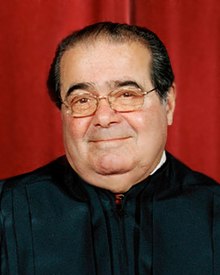
In honor of Human Female's unruly cranium, today's post is dedicated to the justice that is most likely to hurt my head: Antonin Scalia.


First, let me just say, Justice Scalia is incredibly intelligent. I mean no disrespect to him, especially since I intend to argue before him one day (it could happen, picture me at a podium. I know, too cute for words, right?)

Scalia's style has been described as “Catholic-school headmistress meets Vladimir Nabokov.” 

He is known for scathing dissents and open swipes at his fellow justices within his written opinions. (The juiciest, in my opinion, he reserves for lengthy footnotes). He has been described as having a “pugnacious wit.” Toobin, Jeffrey. The Nine: Inside the Secret World of the Supreme Court, Anchor Books, Page 54. He is the quintessential Originalist.

Backing up for a second: Originalism is a type of constitutional interpretation that bases decisions upon the intent of the drafters of the constitution. The text of the constitutions should be interpreted, the Originalists believe, within the context of the Founding Fathers' intent.

This can lead to interesting problems. For example, there was no such thing as a computer (using the modern understanding of the term, Human Male would want me to note) in the 1770's. When the Court reviews cases dealing with the internet, the Originalists would seek to analogize to something that did exist in the 1770's, i.e. newspapers perhaps. The problem is that, while both may be means of transmission of information, there are essential differences. A newspaper spreads information much slower than the internet. A blogger can spew forth information from her blackberry onto the internet. A newspaper reporter has a day to interview, collect information, etc. Depending on the issue in question, such differences can be critical.

It is how Originalists deal with social issues, however, that most hurts my head. I offer the case of Michael H. v. Gerald D., a 1989 Supreme Court case with an opinion authored by Justice Scalia, by way of explanation. 491 U.S. 110 (1989).

The facts of the case are less interesting than anything that goes on in my apartment building on any given Thursday night. Gerald was married to Carole. Id. Carole had an affair with Michael, and became pregnant with his child, a girl named Victoria, (the paternity was confirmed by a blood test). Carole, along with Victoria, moved in with Michael, and Victoria knew him as “Daddy.” Id. Eventually, however, Carole and Victoria went back to Gerald, and Carole and/or Gerald refused to let Michael see Victoria. Michael sought visitation. Id.

Here's where the legal stuff comes in. (That's why you read this blog, right? Not just my whiskered face?) California, the state giving rise to the case, had a statute that stated that any child born of a married woman, “cohabiting with her husband” is proof that the child is her husband's, unless within two years of the child's birth, paternity had been established, (presumably through the courts). Id. Citing Cal. Evid. Code §621. Because Michael hadn't done so, and couldn't now do so, he could never legally be considered Victoria's father. According to the law of California, Gerald was Victoria's father. Since Michael wasn't Victoria's parent, he had no right to seek visitation.

The case reached the Supreme Court challenging the constitutionality of the statute. Michael challenged the law under a violation of Due Process; in order to prevail, he had to convince the Court that the State of California did not have a good enough reason to deny him of a fundamental right to have a relationship with his daughter. (I'm oversimplifying this, but bear with me, I'm a very tired kitten.)

The State's purported interest was that of protecting marital unions and preventing “inquiries into the child's paternity that would be destructive of family integrity and privacy.” Id. Personally, I've gotta think that once a child has been told first one man, and then another, is her father, family integrity has gone the way of the bag of poop Human Female takes from my litter-box.

In order to determine if Michael had a “fundamental” right, that could not be trampled upon by the State of California, the law looks to protections “so rooted in the traditions and conscience of our people as to be ranked as fundamental.”

First rule of Constitutional interpretation: it's all about how you phrase the question. If the question is, “Is a father's relationship with his daughter rooted in the traditions and conscience of our people?” I think I'd be safe in saying the answer is yes. If the question is “Do the traditions and conscience of our people protect the right of a man to break in upon the “sanctity” of a nuclear family” then you begin to understand Justice Scalia.

Indeed, this is the question Scalia asks, and, unsurprisingly, although he looks back to English common law, he cannot find such a tradition. In a pleasantly snarky footnote rebuke of Justice Brennan, who referred to this view of the family as “pinched,” Justice Scalia suggests that a conception of the family “stretched so far as to include the relationship established between a married woman, her lover, and their child, during a three-month sojourn in St. Thomas, or during a subsequent 8-month period when, if he happened to be in Los Angeles, he stayed with her and the child” would cease to have meaning. Id.

Originalism's goal is to preserve a small, core set of (purportedly) common values, and avoid judicial interference in daily life. It assumes that these values are immutable and that those who do not believe in them are non-conformists, who choose to live outside of society's protections.

Because the history of Western society valued nuclear families, to Justice Scalia, nuclear families are worthy of protection, and always will be. Because alternative families are only recently being accepted into American society, they are an aberration, a choice that falls outside the scope of the society that the Founding Fathers intended to preserve. (The term “alternative” family is so loaded that I hesitate to use it; it implies that anything other than a traditional family can only be defined in comparison, but I'm left with little choice.)

It may sound as though I'm coming down harshly on Originalism, but that's because my opinion of the law and the courts in American society is less than democratic. Originalism is the epitome of democratic ideology. By refusing to look past “tradition” and “original intent”, Originalists refuse to interfere, judicially, in any other aspect of society, leaving it to the people, through their elected officials, to effect change. Justice Scalia was not saying that Michael should not have the right to see Victoria, but instead that if society wanted to provide men in his situation with that right, then it should be done through the legislature. Because the legislature is directly responsible to the people, and the courts are not, Originalists are hesitant to make any decisions hinting of societal change from the bench. In essence, then, Originalism views the Court as a goaltender, preserving core values from otherwise rampant democracy. The problem, however, is that there is no such thing as core values, or if there is, it necessarily excludes anything outside of the mostly white, mostly male, mostly economically stable viewpoint.

So that's my good friend Nino. I hear ice cream, off I go, for a well deserved reward, whether the Humans agree or not.