Faithful readers may have noticed that
there was no post on Friday. Unfortunately, Human Female was
suffering from an extended migraine, and I was occupied on snuggle
duty. I even climbed into the dreaded shower with her because I was
so worried she wasn't getting out. Today's post will be
comparatively short too, since I am one exhausted kitten.
I'm starting a new series here on The
Purrdict entitled “Know Your Justices.” Most people can name
their elected representatives, but have trouble naming all nine
Supreme Court justices. (I'll wait while you try...) There are
those among us who follow the the SCOTUS like others follow baseball,
but you “normals” can be forgiven for thinking that the
“greenhouse effect” refers to the ozone layer. So, in the furry
public spirit that is The Purrdict, let me introduce you.
In honor of Human Female's unruly
cranium, today's post is dedicated to the justice that is most likely
to hurt my head: Antonin Scalia.
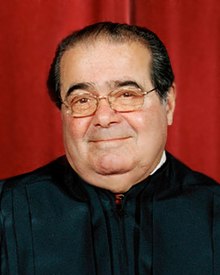
First, let me just say, Justice Scalia is incredibly intelligent. I mean no disrespect to him, especially since I intend to argue before him one day (it could happen, picture me at a podium. I know, too cute for words, right?)
Scalia's style has been described as
“Catholic-school
headmistress meets Vladimir Nabokov.”
He
is known for scathing dissents and open swipes at his fellow justices
within his written opinions. (The juiciest, in my opinion, he
reserves for lengthy footnotes). He has been described as having a
“pugnacious wit.” Toobin, Jeffrey. The Nine: Inside the Secret World of the Supreme Court, Anchor Books, Page 54. He is the quintessential
Originalist.
This
can lead to interesting problems. For example, there was no such
thing as a computer (using the modern understanding of the term,
Human Male would want me to note) in the 1770's. When the Court
reviews cases dealing with the internet, the Originalists would seek
to analogize to something that did exist in the 1770's, i.e.
newspapers perhaps. The problem is that, while both may be means of
transmission of information, there are essential differences. A
newspaper spreads information much slower than the internet. A
blogger can spew forth information from her blackberry onto the
internet. A newspaper reporter has a day to interview, collect
information, etc. Depending on the issue in question, such
differences can be critical.
It
is how Originalists deal with social issues, however, that most hurts
my head. I offer the case of Michael
H. v. Gerald D.,
a 1989 Supreme Court case with an opinion authored by Justice Scalia,
by way of explanation. 491 U.S. 110 (1989).
The
facts of the case are less interesting than anything that goes on in
my apartment building on any given Thursday night. Gerald was
married to Carole. Id. Carole had an affair with Michael, and
became pregnant with his child, a girl named Victoria, (the paternity
was confirmed by a blood test). Carole, along with Victoria, moved
in with Michael, and Victoria knew him as “Daddy.” Id.
Eventually, however, Carole and Victoria went back to Gerald, and
Carole and/or Gerald refused to let Michael see Victoria. Michael
sought visitation. Id.
Here's
where the legal stuff comes in. (That's why you read this blog,
right? Not just my whiskered face?) California, the state giving rise
to the case, had a statute that stated that any child born of a
married woman, “cohabiting with her husband” is proof that the
child is her husband's, unless within two years of the child's birth,
paternity had been established, (presumably through the courts). Id.
Citing Cal. Evid. Code §621.
Because Michael hadn't done so, and couldn't now do so, he could
never legally be considered Victoria's father. According to the law
of California, Gerald was Victoria's father. Since Michael wasn't
Victoria's parent, he had no right to seek visitation.
The
case reached the Supreme Court challenging the constitutionality of
the statute. Michael challenged the law under a violation of Due
Process; in order to prevail, he had to convince the Court that the
State of California did not have a good enough reason to deny him of
a fundamental right to have a relationship with his daughter. (I'm
oversimplifying this, but bear with me, I'm a very tired kitten.)
The
State's purported interest was that of protecting marital unions and
preventing “inquiries into the child's paternity that would be
destructive of family integrity and privacy.” Id. Personally, I've
gotta think that once a child has been told first one man, and then
another, is her father, family integrity has gone the way of the bag
of poop Human Female takes from my litter-box.
In
order to determine if Michael had a “fundamental” right, that
could not be trampled upon by the State of California, the law looks
to protections “so rooted in the traditions and conscience of our
people as to be ranked as fundamental.”
First
rule of Constitutional interpretation: it's all about how you phrase
the question. If the question is, “Is a father's relationship with
his daughter rooted in the traditions and conscience of our people?”
I think I'd be safe in saying the answer is yes. If the question is
“Do the traditions and conscience of our people protect the right
of a man to break in upon the “sanctity” of a nuclear family”
then you begin to understand Justice Scalia.
Indeed,
this is the question Scalia asks, and, unsurprisingly, although he
looks back to English common law, he cannot find such a tradition.
In a pleasantly snarky footnote rebuke of Justice Brennan, who
referred to this view of the family as “pinched,” Justice Scalia
suggests that a conception of the family “stretched so far as to
include the relationship established between a married woman, her
lover, and their child, during a three-month sojourn in St. Thomas,
or during a subsequent 8-month period when, if he happened to be in
Los Angeles, he stayed with her and the child” would cease to have
meaning. Id.
Originalism's
goal is to preserve a small, core set of (purportedly) common values,
and avoid judicial interference in daily life. It assumes that these
values are immutable and that those who do not believe in them are
non-conformists, who choose to live outside of society's protections.
Because
the history of Western society valued nuclear families, to Justice
Scalia, nuclear families are worthy of protection, and always will
be. Because alternative families are only recently being accepted
into American society, they are an aberration, a choice that falls
outside the scope of the society that the Founding Fathers intended
to preserve. (The term “alternative” family is so loaded that I
hesitate to use it; it implies that anything other than a traditional
family can only be defined in comparison, but I'm left with little
choice.)
It
may sound as though I'm coming down harshly on Originalism, but
that's because my opinion of the law and the courts in American
society is less than democratic. Originalism is the epitome of
democratic ideology. By refusing to look past “tradition” and
“original intent”, Originalists refuse to interfere, judicially,
in any other aspect of society, leaving it to the people, through
their elected officials, to effect change. Justice Scalia was not
saying that Michael should not have the right to see Victoria, but
instead that if society wanted to provide men in his situation with
that right, then it should be done through the legislature. Because
the legislature is directly responsible to the people, and the courts
are not, Originalists are hesitant to make any decisions hinting of
societal change from the bench. In essence, then, Originalism views
the Court as a goaltender, preserving core values from otherwise
rampant democracy. The problem, however, is that there is no such
thing as core values, or if there is, it necessarily excludes
anything outside of the mostly white, mostly male, mostly
economically stable viewpoint.
So
that's my good friend Nino. I hear ice cream, off I go, for a well
deserved reward, whether the Humans agree or not.

No comments:
Post a Comment